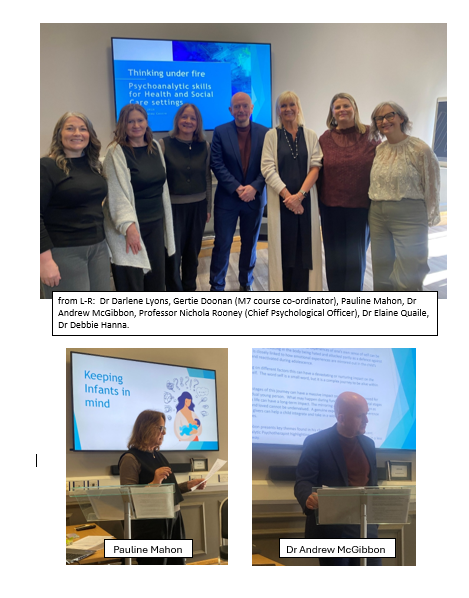
On the 22nd April 2026, ACP Members in Northern Ireland successfully held the conference 'Thinking under Fire: Psychoanalytic skills for health and social care settings' which aimed to highlight how a psychoanalytic approach can complement mental health and social care practice across the lifespan.
There were four presentations from ACP Child & Adolescent Psychotherapists covering different areas of work within the health service:
Pauline Mahon – Perinatal Service
Dr Darlene Lyons & Gillian Moore- Family Support
Dr Debbie Hanna - Reflective Groups
Dr Andrew McGibbon - Body Wars.
The conference was attended by qualified Child & Adolescent Psychotherapists and CAPTs in training, current or graduate students of the M7 infant observation course ( Perinatal, Child, Adolescent and Family Work: a Psychoanalytic Observational Approach MA (Belfast) - Tavistock Education and Training) as well as professionals from Education, CAMHS, social services, and paediatrics interested in working psychoanalytically.
The conference attendees were delighted that Professor Nichola Rooney, Chief Psychological Officer attended the event and accepted the invitation to address the audience and acknowledged the theme of the conference, in particular considering ‘how we think under pressure’, and how it could not be more relevant to those of us working in public services, particularly health and social care, and education.
The conference was an opportunity to acknowledge that our workforces are operating in environments of increasing demand, complexity, and emotional intensity. The ability to pause, reflect, and make sense of what is happening, both within ourselves, and in our interactions with others, is fundamental to safe, effective, and compassionate care. Psychoanalytic thinking offers us a vital framework for this. It enables us to remain curious in the face of distress, to understand behaviour as communication, and to recognise the often-unseen emotional and relational dynamics that influence outcomes. These are essential capabilities for a modern, psychologically informed workforce.
The distinctive contribution of ACP Child and Adolescent Psychotherapists, particularly in Northern Ireland was recognised and their unique, highly specialised body of knowledge and skills including a deep understanding of early development, attachment, trauma, and the unconscious processes that shape how individuals experience the world from infancy. These are profoundly relevant across the lifespan as we see the patterns formed in early relationships echo into adulthood, parenting and later life including how we relate to others and within systems. The contribution of Child Psychotherapy also extends well beyond direct therapeutic work, as ACP Child & Adolescent Psychotherapists play a crucial role in supporting teams and systems, offering consultation, reflective practice, and formulations that help other professionals to think more clearly and respond more effectively, particularly when 'thinking under fire' in complex and high-risk situations whatever the setting or client group.
Feedback from attendees included:
‘It was a very rich practice experience’.
‘The event was fantastic! It was wonderful to be in a room in shared conversation with so many professionals who want to explore and then support the 'unmet need'.
‘Detailed presentations of in-depth work delivered in very accessible manner’.